While most adult UK butterflies die off in the autumn, the next generation surviving the winter as eggs, caterpillars, or chrysalises, five common species overwinter as hibernating adults: brimstone (which we wrote about with their antifreeze body fluid last year), comma, small tortoiseshell, red admiral and peacock.
The one you are most likely to see flying on a warm winter day is the peacock. This large and strong flying butterfly was voted Britain’s favourite in a recent survey by Butterfly Conservation. The distinctive large eye-spots, one on each of the four wings, are really striking and a link to both its common and scientific names.

The eye-spots act as a defence by startling or confusing predators as the wings are opened and closed when the butterfly is settled on a plant. It is easy to link them to those on the tail of a peacock, although the bird’s display is to attract a female rather than scare away predators. The scientific name is Aglais io which translates as ‘splendid Io’. Io was a water nymph protected by the 100-eyed giant Argus and the butterfly’s eye-spots protect its vulnerable body.
The eye-spots are in stark contrast to the dowdy dark undersides of the wing. When closed, the wings are very good camouflage looking like a dead leaf, and their drabness makes the sudden appearance of the eye-spots as the wings flick open even more startling.
During the summer, adult peacock butterflies feed on nectar. They are a common sight on garden buddleia, although much less common than fifty years ago, but their main habitat is in woodland glades where thistles are one of their favourite food sources.
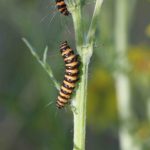
Eggs are laid on the underside of nettle leaves. The black, prickly caterpillars hatch after between one and three weeks depending on the weather. They tend to stay together and can be found clustered at the top of the plants munching away on the youngest growth while protected by a network of silken threads.
When fully developed after about a month, the caterpillars disperse and find a hidden spot under a leaf to pupate. They fix themselves head down and split and shuffle off their skin to reveal a chrysalis which is camouflaged grey and brown.

The miracle of metamorphosis into an adult takes two to four weeks. The new adults force their way out of the chrysalis but then have to pump fluid into the crumpled wings and rest as they harden.
The adults spend the next months feeding and building up fat reserves. They hibernate over winter in hollow trees, woodpiles, or sheds, waking up in March or April to mate and restart the cycle.
You might also see red admirals flying in winter. In the past, adults were summer migrants, arriving from North Africa and continental Europe in late spring and laying eggs. The new generation would then fly back south in the autumn. As our climate changes and our winters warm, many now stay. Like the other winter flyers, they do not enter deep dormancy, resting in sheltered places and flying to feed in mild weather.
Ed Dolphin
Related Posts: